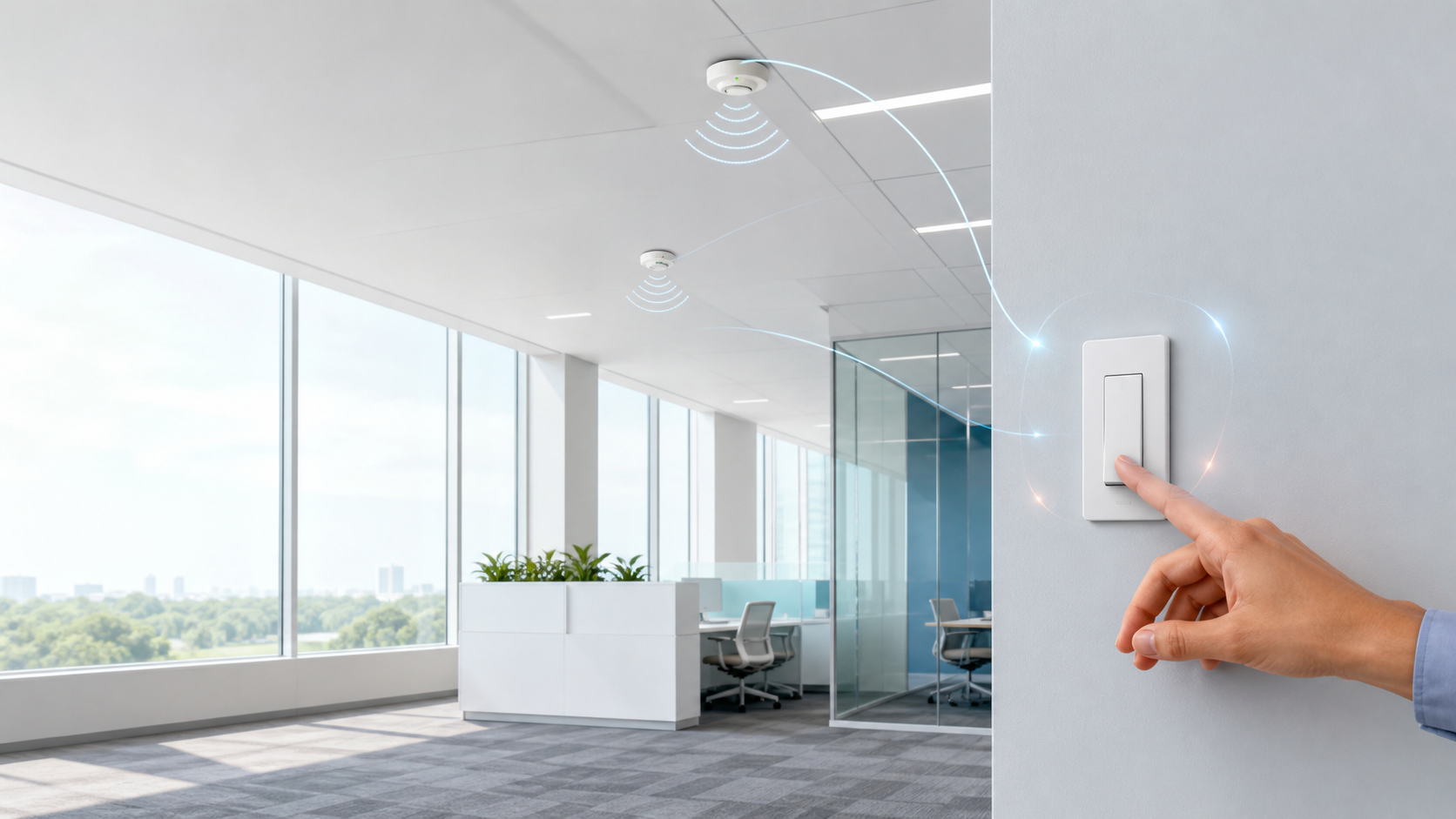
How wireless controls, energy harvesting, and thoughtful system design can create more flexible, serviceable commercial buildings.
LESS WIRE. FEWER BATTERIES. MORE FLEXIBILITY.
Table of contents
- What Are Wireless Building Controls?
- How Do Wireless Building Control Systems Work?
- What Is EnOcean Technology?
- Why Energy Harvesting Matters in Wireless Building Automation
- Wireless Building Controls vs. Wired Building Controls
- 10 Benefits of Wireless Building Controls
- Where Do Wireless Lighting Controls Make the Most Sense?
- Wireless Controls for New Construction
- Wireless Controls for Building Retrofits
- Wireless Occupancy Sensors and Energy Savings
- Daylight Harvesting and Wireless Controls
- Wireless Building Controls and Energy Codes
- The Hidden Value: Avoiding Future Construction
- Pre-Commissioned Wireless Building Controls
- Remote Commissioning and Troubleshooting
- Cybersecurity and Wireless Building Controls
- Are Wireless Building Controls Reliable?
- Is EnOcean Better Than Wi-Fi, Bluetooth, or Zigbee for Building Controls?
- Why Energywise Solutions Uses EnOcean Wireless Technology
- Wireless Building Controls Are About More Than Eliminating Wire
- Should Your Building Use Wireless Controls?
- Talk to Energywise Solutions About Wireless Building Controls
Building controls have traditionally depended on one basic assumption: if you want to control something in a building, you need to run a wire to it.
That assumption is changing.
Wireless building controls are giving building owners, facility managers, contractors, architects, and engineers new ways to control lighting, HVAC, occupancy sensors, switches, and other building systems without installing dedicated control wiring to every device.
But eliminating wires is only part of the story.
The real advantage of a well-designed wireless building automation system is flexibility. Buildings change. Tenants change. Furniture moves. Operating schedules evolve. Walls are added or removed. Spaces that were designed for one purpose are eventually used for something completely different.
A building control system needs to be able to adapt with them.
At Energywise Solutions, we design and support wired, wireless, and hybrid building control systems. For many wireless applications, EnOcean wireless technology is one of our preferred technologies because of its unique combination of wireless communication and energy-harvesting capabilities.
The result can be a control system with less wiring, fewer batteries, greater flexibility, and a much easier path for future changes.
What Are Wireless Building Controls?
Wireless building controls use radio-frequency communication rather than dedicated control wiring to allow devices within a building to communicate.
- Wireless wall switches
- Occupancy and vacancy sensors
- Daylight sensors
- Lighting controllers
- Dimmers
- Relays
- Room controllers
- HVAC sensors and controls
- Temperature sensors
- Door and window sensors
- Building automation devices
- Gateways and system interfaces
In a traditional wired control system, a physical pathway must typically connect control devices to other components within the system.
Wireless controls can eliminate some of those physical connections.
That distinction can become particularly important in existing buildings where adding control wiring means accessing ceilings, opening walls, installing conduit, moving furniture, interrupting operations, or working around architectural finishes.
Wireless technology can also provide significant advantages in new construction by reducing unnecessary control wiring while creating a more adaptable building from the beginning.
How Do Wireless Building Control Systems Work?
A wireless building control system allows devices to exchange commands and information over a wireless network.
Consider a simple wall switch.
In a conventional installation, pressing the switch causes something to happen through a physical electrical or control connection.
With a wireless lighting control system, the switch can instead transmit a wireless command to a receiver or controller. The controller then performs the programmed function.
- Turning lights on or off
- Dimming a lighting zone
- Activating a preset scene
- Changing the operation of multiple fixtures
- Triggering a building automation sequence
The same basic concept can be applied to occupancy sensors, daylight sensors, temperature sensors, and other building control devices.
The exact architecture depends on the application, which is why wireless controls should be designed as a system rather than purchased as a collection of individual wireless products.
What Is EnOcean Technology?
EnOcean is a wireless technology widely associated with building automation and energy-harvesting control devices.
One of the characteristics that makes EnOcean particularly interesting for commercial building controls is its ability to support devices that can generate or harvest the small amounts of energy needed for their operation.
- Mechanical movement
- Ambient light
- Differences in temperature
This can allow certain EnOcean devices to communicate wirelessly without requiring traditional control wiring and, in applicable devices, without depending on routinely replaced batteries.
A wireless wall switch provides an easy example.
The physical action of pressing an energy-harvesting switch can generate enough energy for the device to transmit a wireless command.
Think about what that means from a building-design perspective.
- No dedicated control wire to the switch.
- No electrical box may be required for certain applications and configurations.
- No routine switch battery replacement for an appropriate energy-harvesting device.
- The switch is not necessarily permanently tied to one location simply because that is where control wiring was installed during construction.
Why Energy Harvesting Matters in Wireless Building Automation
When people first hear about wireless controls, the natural reaction is often: Don’t wireless devices need batteries?
Many do. And that deserves consideration when evaluating wireless building automation technologies.
A few batteries may not seem significant. But imagine a large commercial building, school, retail portfolio, warehouse, office complex, or multi-site business with hundreds or thousands of wireless devices.
Every battery eventually becomes a maintenance item.
Someone has to identify the failed device, locate it, access it, replace the battery, verify its operation, and maintain an inventory of the correct replacement batteries.
Multiply that process across a portfolio of buildings and battery maintenance can become a real operational issue.
Energy harvesting changes the conversation.
Where appropriate batteryless EnOcean sensors and switches can be used, building owners may reduce the number of batteries that become part of the facility’s long-term maintenance requirements.
That is one of the reasons Energywise Solutions considers EnOcean when evaluating wireless control applications.
Wireless Building Controls vs. Wired Building Controls
There isn’t a universal answer to whether wired or wireless building controls are better.
The correct answer depends on the building.
Wired systems can offer excellent reliability and may be appropriate for applications where permanent infrastructure is easy to install and unlikely to change.
Wireless controls can provide advantages where installing control wiring is expensive, disruptive, difficult, or unnecessarily restrictive.
The most effective solution may also be a hybrid building control system combining wired and wireless technologies.
The question shouldn’t be: Should we use wired or wireless controls?
A better question is: What control architecture provides the best performance, flexibility, serviceability, and long-term value for this building?
10 Benefits of Wireless Building Controls
1. Reduced Control Wiring
One of the most obvious advantages of wireless building controls is the potential to reduce dedicated control wiring. Less wiring can mean fewer pathways, less conduit, fewer penetrations, and less installation labor depending on the project.
2. Easier Installation in Existing Buildings
Retrofit projects can be challenging because walls and ceilings are already finished. Wireless lighting controls and wireless sensors can help reduce the amount of invasive construction required to add modern controls to an existing building.
3. Greater Flexibility
Wireless switches and sensors can potentially be relocated without installing new control wiring. That can be extremely valuable when a facility is renovated or reconfigured.
4. Reduced Disruption
Adding conventional control wiring to an occupied facility can interfere with normal business operations. Wireless building automation may reduce the amount of disruptive construction required.
5. Easier Future Changes
The control requirements established during construction may not be the requirements the building has five years later. Wireless controls can provide a more flexible path for future modifications.
6. Improved Retrofit Opportunities
Older commercial buildings may benefit from modern occupancy controls, daylight harvesting, scheduling, and other energy-saving strategies but lack the necessary control wiring. Wireless controls can help bridge that gap.
7. Potential Reduction in Battery Maintenance
Energy-harvesting technologies such as EnOcean can reduce reliance on batteries for appropriate wireless switches and sensors.
8. Improved Energy Management
Wireless controls can help make occupancy sensing, scheduling, daylight harvesting, dimming, and other energy-management strategies practical in buildings where installing new control infrastructure would otherwise be difficult.
9. Scalability
A properly designed wireless control system can allow additional devices and controlled areas to be incorporated as building requirements evolve.
10. Better Adaptability
Buildings are not static. A flexible control architecture makes it easier for the building’s operation to evolve with the people using it.
Where Do Wireless Lighting Controls Make the Most Sense?
Wireless lighting controls can be valuable in both new construction and retrofit projects.
Some particularly good applications include existing commercial buildings, tenant improvements, offices, warehouses, schools, retail facilities, restaurants, hospitality properties, healthcare environments, historic buildings, and facilities where walls or ceilings are difficult to access.
They’re also useful in buildings where layouts change regularly.
A wireless switch that can be repositioned is much easier to accommodate than a control point whose location was permanently determined by wiring installed years earlier.
Wireless Controls for New Construction
Wireless technology shouldn’t be viewed strictly as a retrofit solution.
There can be substantial advantages to designing wireless or hybrid controls into a new building.
New construction provides the opportunity to evaluate the entire control architecture before unnecessary wiring is installed.
Instead of automatically following the traditional approach of running control wiring to every device, the design team can determine where wired communication is necessary and where wireless technology provides a better solution.
That can create a cleaner, more flexible infrastructure from day one.
Wireless Controls for Building Retrofits
Retrofits may be where the advantages become most obvious.
Imagine wanting to add occupancy sensing to an existing office.
A conventional approach may require ceiling access, new wiring, conduit, wall penetrations, electrical labor, patching, painting, and disruption to occupied areas.
Depending on the application, wireless controls can dramatically simplify that process.
This can make advanced lighting and building controls practical in facilities where the construction required for a traditional system might otherwise prevent the project from moving forward.
Wireless Occupancy Sensors and Energy Savings
Occupancy and vacancy sensing are important components of many modern commercial lighting control strategies.
A simple principle applies: An unoccupied room usually doesn’t need to be fully illuminated.
Wireless occupancy sensors can provide an effective way to introduce occupancy-based control without installing extensive new sensor wiring.
When properly designed, these strategies can reduce unnecessary lighting operation while improving the automation of the building.
Wireless sensing may also support broader building-management strategies when appropriately integrated with HVAC or other systems.
Daylight Harvesting and Wireless Controls
Buildings with substantial natural light may also benefit from daylight harvesting controls.
Daylight sensors measure available natural light and allow electric lighting to be reduced when sufficient daylight is present.
Wireless sensing can make these strategies easier to implement, particularly in existing buildings.
Combining daylight harvesting with occupancy sensing, scheduling, dimming, and other control strategies can create a more responsive lighting system that adjusts to actual building conditions rather than simply operating at full output for a fixed schedule.
Wireless Building Controls and Energy Codes
Modern energy codes increasingly require lighting control strategies such as occupancy control, automatic shutoff, daylight-responsive controls, and other methods of reducing unnecessary energy consumption.
Wireless technology can provide another tool for designers and contractors working to satisfy applicable control requirements.
However, wireless technology itself does not automatically make a project code compliant.
The control sequence, equipment selection, system design, programming, commissioning, and applicable local energy codes still need to be evaluated for each project.
The Hidden Value: Avoiding Future Construction
The biggest financial advantage of wireless building controls isn’t always visible on the original construction quote.
Consider what happens several years later when a facility needs to move a control point.
With a traditional wired system, that seemingly minor request can involve an electrician, new wiring, conduit, ceiling work, wall repair, painting, programming, and disruption to the occupied space.
With an appropriately designed wireless system, the change may be considerably simpler.
This is why evaluating a control system solely on first cost can miss a significant part of its value.
- Installation cost
- Future modification costs
- Maintenance requirements
- Battery replacement
- System flexibility
- Product availability
- Technical support
- Programming requirements
- Commissioning
- Expansion capabilities
- Long-term serviceability
A control system isn’t just installed. It has to be lived with.
Pre-Commissioned Wireless Building Controls
Another major opportunity is combining wireless technology with pre-commissioning.
Energywise Solutions can design and configure control systems before equipment reaches the project site, depending on the application.
Pre-commissioning can reduce the amount of field programming required and simplify installation.
Instead of requiring every component of the control system to be created from scratch on the jobsite, much of the system logic can be developed in advance.
This can be particularly useful for repeatable building designs, multi-location businesses, restaurants, retail facilities, franchise concepts, and other organizations developing multiple locations.
Remote Commissioning and Troubleshooting
Wireless and networked control technologies can also create opportunities for remote technical support.
That’s important because building controls don’t stop requiring support when construction ends.
- Change a schedule
- Modify a sensor
- Relocate a switch
- Adjust a lighting zone
- Replace a device
- Troubleshoot an operational issue
- Change the sequence of operations
Energywise Solutions approaches controls as a long-term building system rather than simply another box of products delivered to a construction site.
Cybersecurity and Wireless Building Controls
Any discussion about connected building technology should include security.
Not every wireless control device connects directly to the internet, and wireless communication should not automatically be confused with internet connectivity.
Nevertheless, system architecture matters.
Network-connected gateways, building management systems, remote-access interfaces, and integrations should be evaluated with appropriate consideration for cybersecurity, access permissions, network design, and ongoing system management.
Wireless building controls should be designed with both operational performance and network security in mind.
Are Wireless Building Controls Reliable?
This is one of the most common questions surrounding wireless building automation.
The answer depends heavily on system design.
Wireless performance can be affected by building materials, distances, device placement, interference, network architecture, and the technology being used.
That is why wireless controls shouldn’t simply be scattered throughout a building and expected to work.
A professional control design should evaluate the building environment, communication pathways, device locations, control sequences, and system requirements.
Good wireless performance starts with good design.
Is EnOcean Better Than Wi-Fi, Bluetooth, or Zigbee for Building Controls?
There is no single wireless protocol that is best for every application.
Wi-Fi, Bluetooth, Zigbee, EnOcean, and other technologies have different characteristics and use cases.
For Energywise Solutions, the attraction of EnOcean building controls is particularly strong when energy-harvesting devices, low-maintenance sensors and switches, flexibility, and commercial building automation are important to the project.
Rather than selecting a wireless technology because it is popular, the protocol should be selected based on what the building needs to accomplish.
Why Energywise Solutions Uses EnOcean Wireless Technology
Our preference for EnOcean in appropriate applications comes down to a few fundamental principles.
- Flexible – the system should be capable of adapting as the building changes.
- Serviceable – a building owner shouldn’t be left wondering how to maintain or modify the control system years later.
- Efficient – controls should help reduce unnecessary energy consumption without creating unnecessary complexity.
- Practical – technology should solve problems rather than create new ones.
- Maintainable – reducing unnecessary wiring is valuable; reducing unnecessary battery maintenance can be valuable too.
EnOcean gives us an effective technology platform for accomplishing these objectives in many commercial building applications.
Wireless Building Controls Are About More Than Eliminating Wire
It is easy to look at wireless controls and focus on the most obvious advantage: You don’t have to run as much control wire.
But that’s not where the real story ends.
The larger advantage is creating a building that is easier to change.
Today’s office won’t necessarily have the same layout five years from now.
Today’s operating schedule won’t necessarily be tomorrow’s schedule.
Today’s tenant may not be tomorrow’s tenant.
And today’s building technology certainly won’t be the last technology installed in the facility.
A good building control system needs to recognize that reality.
Should Your Building Use Wireless Controls?
The answer should come from an evaluation of the building – not from a product catalog.
Energywise Solutions works with business owners, facility managers, contractors, architects, engineers, developers, and other project stakeholders to design commercial lighting and building control systems around the actual requirements of the facility.
That may mean wired controls. It may mean wireless controls. It may mean a hybrid of both.
And when wireless technology is appropriate, EnOcean is one of the platforms we frequently consider because of its energy-harvesting capabilities, flexibility, and suitability for commercial building automation.
The goal isn’t to make the building wireless. The goal is to make the building work better.
Talk to Energywise Solutions About Wireless Building Controls
If you’re designing a new commercial building, planning a lighting retrofit, renovating an existing facility, or evaluating an outdated building control system, it may be worth reviewing the control architecture before automatically installing more wiring.
Energywise Solutions can help evaluate your lighting and building-control requirements and determine whether wired, wireless, or hybrid controls provide the best solution.
We can also evaluate opportunities for EnOcean wireless controls, wireless lighting controls, occupancy sensing, daylight harvesting, pre-commissioned controls, remote system support, and integrated building energy management.
Before you run another control wire, ask whether you actually need one.