Table of contents
- How metameric white light affects temperature perception
- What the research suggests about cooling energy savings
- Why color temperature alone does not tell the whole story
- Coordinating lighting, HVAC and building controls
- What commercial building owners can do today
- Book a Free 20-Minute Lighting and Building Controls Consult
What Penn State research could mean for comfort, HVAC demand and the way commercial buildings are managed
When someone in your building says it feels too warm, the response usually starts at the thermostat. Lower the setting, wait for the air conditioning to catch up, and hope the complaint goes away. But what if part of that person’s experience is being influenced by something overhead?
Research from Penn State raises that possibility. Subtle changes in white light may affect how people experience temperature, even when the lighting looks the same. For building owners and facility teams, the findings invite a closer look at how lighting, comfort and energy use fit together. Penn State research overview
The work is preliminary. Its commercial value today is the question it puts in front of us: how much more could we accomplish by evaluating the indoor environment as a whole?
How metameric white light affects temperature perception
The researchers used metameric white light: two light sources that appeared alike but contained different mixtures of wavelengths. One was enriched in shorter blue wavelengths; the other in longer red wavelengths. Ten participants experienced these conditions while room temperatures gradually rose and fell.
During warming, blue-enriched white light delayed requests for a temperature adjustment, corresponding to an average tolerated temperature about 0.7°C, or 1.3°F, higher. During cooling, red-enriched white light was associated with warmer reported sensations. Those were different response measures; the experiment did not establish an identical effect in both directions. Original study in Energy and Buildings
The intriguing detail is that the participants were not sitting beneath visibly blue or red lamps. The experiment examined differences within white light that looked essentially identical. That makes the research more relevant to ordinary workplaces, where lighting still needs to support comfortable, accurate vision. Penn State research overview
What the research suggests about cooling energy savings
The researchers also modeled the energy implications of widening thermostat setpoints by 0.5°C, approximately 0.9°F. Across representative climate zones, simulations projected cooling-energy savings of 5.2% to 11.4%. These were modeled outcomes, not savings measured in operating commercial buildings. Original study
For an owner evaluating an investment, that distinction changes how the numbers should be used. They establish a reason for further investigation, but they do not provide a savings forecast for a particular property. Cooling energy is also only one part of a building’s consumption; the percentages cannot be applied directly to the entire utility bill.
The business proposition is worth exploring: if occupants can remain comfortable across a slightly wider temperature range, there may be opportunities to reduce cooling demand. Any eventual project would need to evaluate the complete economics, including lighting performance, equipment costs, control requirements and actual energy use.
Why color temperature alone does not tell the whole story
A fixture specification commonly lists a correlated color temperature, or CCT, such as 3000K or 5000K. That describes the apparent warmth or coolness of its white light. It does not fully describe the mixture of wavelengths producing that appearance. Metameric lighting can have similar visual characteristics while differing in spectral composition. Review of physiological responses to light
The wider research also deserves attention. A separate 2026 study involving 464 experimental sessions across eight test rooms examined conventional white-light settings around 3000K, 4000K and 6000K. It found no statistically significant support for the idea that those CCT changes altered thermal sensation or preference under the tested conditions. Beyond hue and heat
The experiments tested different lighting conditions and cannot be treated as interchangeable. Together, they suggest that the relationship is more complicated than choosing a higher Kelvin number on a specification sheet. My takeaway is to follow the spectral research closely while keeping purchasing decisions grounded in demonstrated performance.
Coordinating lighting, HVAC and building controls
At Energywise Solutions, this research fits a broader way of thinking about facilities. Lighting, HVAC and controls all contribute to the environment people experience, and their operation should be reviewed together.
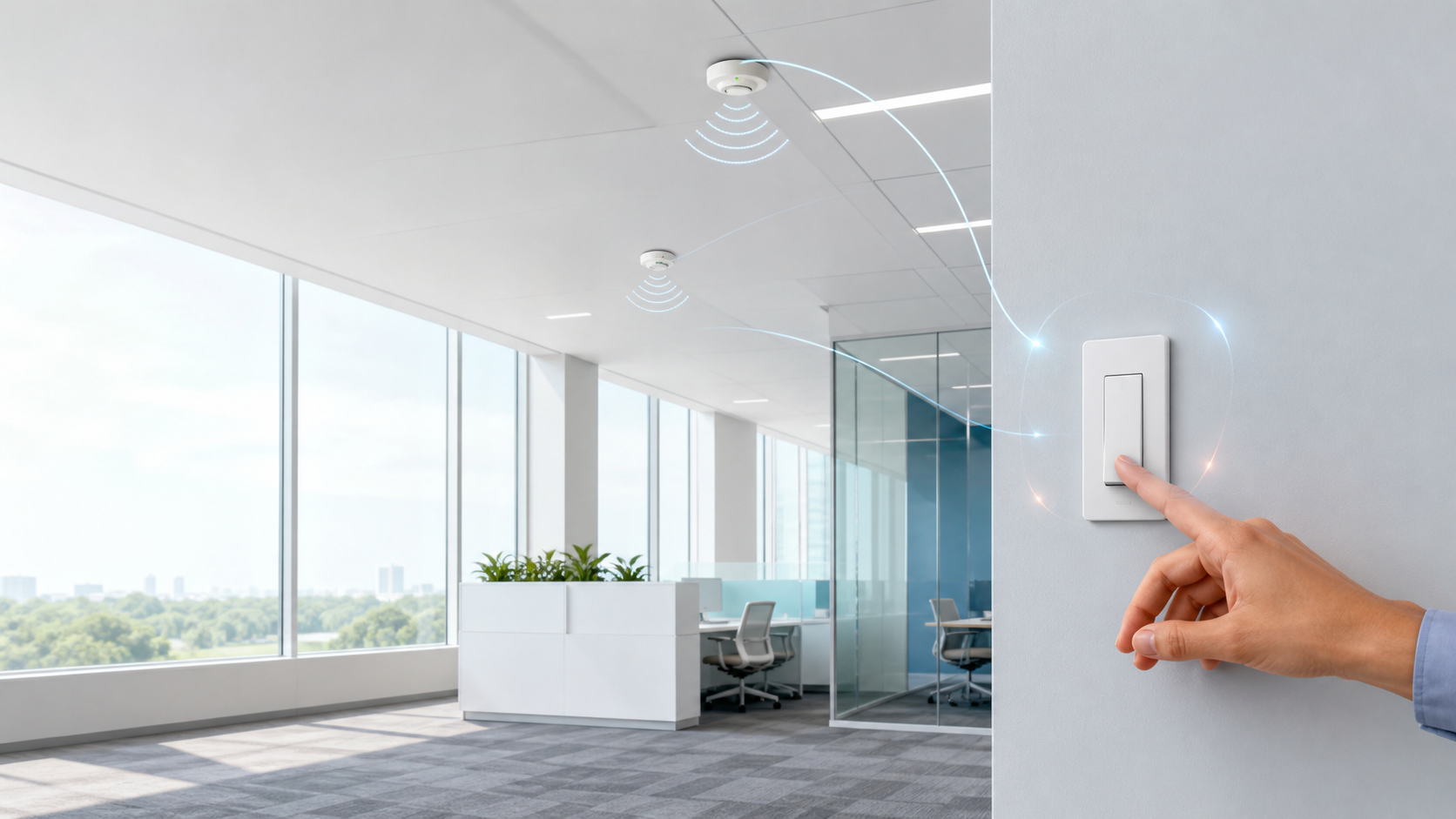
Consider a hypothetical office where the lighting responds to occupancy but the HVAC follows a schedule established years earlier. Understanding when the space is actually used could help the facility team evaluate both systems. That review can begin with existing schedules, sensors and controls, along with comfort complaints and equipment runtime.
The practical questions are straightforward. Which existing devices can share useful information? Where do operating hours differ from actual use? What adjustments can be made while maintaining ventilation, humidity control and comfort? How will the team measure whether the change worked?
EnergyManager is one option within that discussion, with capabilities for monitoring and controlling systems such as lighting and HVAC in applicable configurations. Its suitability depends on the building and installed equipment. Energywise building controls
Our manufacturer-agnostic approach starts with those requirements and the investments a customer has already made. Product selection follows an assessment of compatibility, performance, serviceability and cost. Any future application of spectrum-based comfort control would need the same scrutiny.At Energywise Solutions, this research fits a broader way of thinking about facilities. Lighting, HVAC and controls all contribute to the environment people experience, and their operation should be reviewed together.
Consider a hypothetical office where the lighting responds to occupancy but the HVAC follows a schedule established years earlier. Understanding when the space is actually used could help the facility team evaluate both systems. That review can begin with existing schedules, sensors and controls, along with comfort complaints and equipment runtime.
The practical questions are straightforward. Which existing devices can share useful information? Where do operating hours differ from actual use? What adjustments can be made while maintaining ventilation, humidity control and comfort? How will the team measure whether the change worked?
EnergyManager is one option within that discussion, with capabilities for monitoring and controlling systems such as lighting and HVAC in applicable configurations. Its suitability depends on the building and installed equipment. Energywise building controls
Our manufacturer-agnostic approach starts with those requirements and the investments a customer has already made. Product selection follows an assessment of compatibility, performance, serviceability and cost. Any future application of spectrum-based comfort control would need the same scrutiny.
What commercial building owners can do today
Penn State describes its work as exploratory. The study involved ten adults ages 18 to 35 in a controlled setting, and the researchers plan broader testing. That leaves important questions about how reliably the findings would translate to diverse occupants and everyday buildings. Penn State research overview
I would not use this experiment alone to raise thermostat settings or justify a lighting purchase. I would use it to broaden the conversation during the next facility review. Alongside fixture efficiency and HVAC performance, ask how the systems will operate together and how occupant feedback will inform adjustments.
That is a useful discipline regardless of where the research leads. A project should have clear operating goals, a way to verify performance and someone responsible for reviewing the results after installation. Those expectations help owners distinguish a promising concept from a practical improvement.
The next time a room feels too warm, the thermostat will still deserve attention. This research gives us a reason to look more closely at the rest of the environment, too.
Book a Free 20-Minute Lighting and Building Controls Consult
| If you are evaluating a lighting upgrade or reviewing building controls, Energywise Solutions can help you identify useful existing assets, opportunities for better coordination and practical next steps for your facility. |