Table of Contents
- Why a Photometric Study Matters
- 1. Begin With the Project Goal
- 2. Verify the Inputs and Layout Assumptions
- 3. Understand What Is Being Measured
- 4. Review Average Light Levels in a Photometric Study
- 5. Review Uniformity Carefully
- 6. Study the Point Grid and Contour Pattern
- 7. Evaluate Glare in a Photometric Study
- 8. Review Spill Light and Site Context
- 9. Compare Every Photometric Study on the Same Basis
- 10. What a Photometric Study Does Not Resolve
- Questions to Ask Before Approval
- When a Second Opinion Is Useful
- Better Decisions Start With a Better Photometric Study Review
A court lighting proposal can look polished, but knowing how to read a photometric study can reveal important performance questions that still need answers.
Fixture schedules, wattage, lumen output, and equipment pricing all matter. But none of those items, by themselves, show how the proposed system is expected to perform across the actual playing area. That is the job of the photometric study.
A photometric study uses the proposed fixture locations, mounting heights, aiming, optics, and site geometry to calculate expected light levels at defined points. It gives owners and project teams a way to examine the lighting design before equipment is purchased and installed.
The key is knowing what the study does show, what it may not show clearly, and which assumptions deserve a closer look.
This review process is especially important for tennis, pickleball, and padel facilities, where ball speed, player sightlines, overhead tracking, surrounding conditions, and transitions across the court all affect the experience.
Why a Photometric Study Matters
Players do not experience a lighting package as a fixture schedule. They experience whether the ball remains visible, whether parts of the court feel noticeably darker, whether a bright source enters a critical sightline, and whether play remains comfortable over time.
A photometric study helps translate a proposed lighting system into predicted performance. It can help a project team evaluate:
- horizontal illuminance across the playing surface
- uniformity between brighter and darker calculation points
- coverage beyond the painted court boundaries
- the relationship between fixture locations and the court layout
- expected spill light near property lines or neighboring uses
- whether different package options are being compared fairly
A photometric study does not guarantee the final experience. Review it alongside the full lighting design and project requirements. It is one of the most useful design-review tools available when the inputs and evaluation criteria are understood.
1. Begin With the Project Goal
Before reviewing numbers, confirm what the facility is being designed to support.
A private residential court, a community recreation facility, a commercial pickleball club, and a competition venue may have different operating priorities. The appropriate design depends on the level of play, hours of operation, indoor or outdoor conditions, surrounding properties, broadcast or event needs, and owner expectations.
Ask these questions first:
- Which sport or sports will be played?
- Is the facility recreational, commercial, competitive, or multi-use?
- Are there owner, league, governing-body, zoning, or project-specific lighting criteria?
- What boundaries are included in the calculation area?
- Are adjacent courts, circulation areas, seating, and transition zones part of the design?
Without an agreed project goal, a photometric can appear precise while answering the wrong question.
2. Verify the Inputs and Layout Assumptions
Engineers build every photometric study on project assumptions. Review those assumptions before relying on the results.
Confirm the number and location of poles or mounting points, mounting heights, fixture quantities, optics, aiming, court dimensions, orientation, and surrounding structures. For an indoor project, verify ceiling height, structure, surface reflectance assumptions, obstructions, and the proposed mounting relationship to player sightlines.
For a retrofit, confirm that the study reflects actual field conditions rather than an idealized drawing. Existing pole locations, structural capacity, electrical limitations, nearby trees, fencing, and physical obstructions can materially affect what is practical.
If the geometry in the model does not match the project, the calculated results may not represent the system that can actually be installed.
Many lighting performance issues begin with planning mistakes rather than fixture selection alone. Learn about the 7 Court Lighting Mistakes That Create Expensive Problems Later before finalizing your lighting package.
3. Understand What Is Being Measured
Most court lighting photometrics include a grid of calculated values across a horizontal plane. Those values show predicted illuminance at each calculation point, commonly expressed in footcandles or lux.
Do not assume every study uses the same calculation plane, grid spacing, court boundary, or reporting method. Confirm:
- the units being used
- the height and orientation of the calculation plane
- the spacing of calculation points
- whether the grid covers only the striped court or the broader playing area
- whether results represent initial or maintained conditions
- which light-loss assumptions have been applied
These details matter when comparing proposals. A package may appear stronger because it uses different boundaries, grid spacing, or maintenance assumptions.
4. Review Average Light Levels in a Photometric Study
When reviewing a photometric study, average illuminance is useful, but it does not tell the whole story.
Two designs can report a similar average while producing very different distributions. One may deliver balanced coverage, while another reaches the average through several bright areas surrounded by darker zones.
Review the minimum and maximum values alongside the average. Then look at where those points occur. A low value outside a meaningful playing zone may have a different effect than a dark area located where players regularly track the ball or change direction.
The point-by-point grid and visual contour patterns often reveal more than a single summary number.
5. Review Uniformity Carefully
A photometric study should be reviewed for how consistently light is distributed across the calculation area. It is commonly expressed as a ratio, but the exact ratio and convention should be identified rather than assumed.
Better uniformity generally reduces abrupt bright-to-dark transitions and supports more consistent visibility. However, the ratio still needs context. Ask:
- Which points were included in the calculation?
- Is the reported ratio average-to-minimum, maximum-to-minimum, or another measure?
- Are all compared packages using the same calculation area and method?
- Do the lowest values appear in meaningful locations?
A favorable summary ratio should be confirmed by reviewing the actual distribution across the court.
6. Study the Point Grid and Contour Pattern
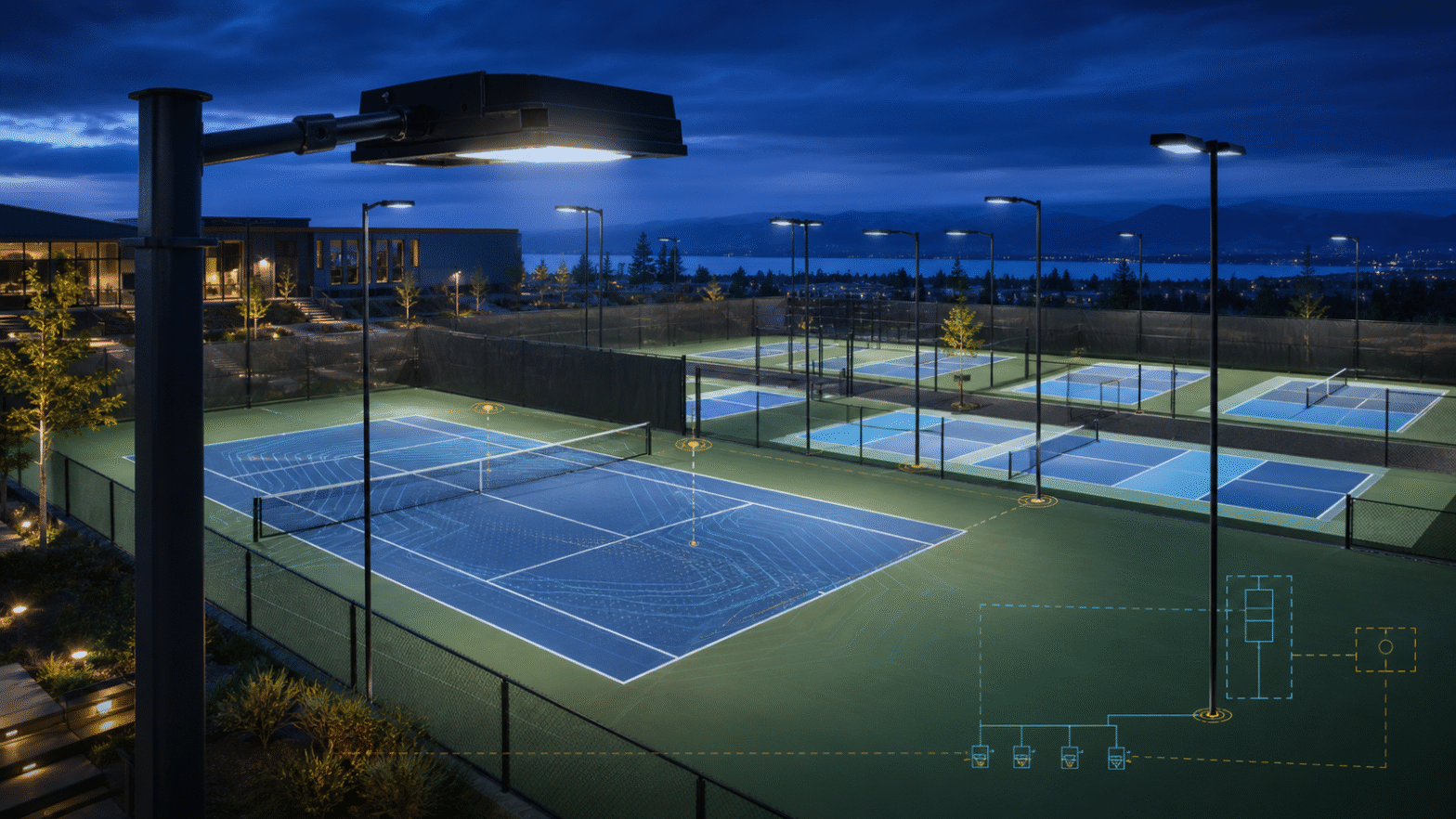
A photometric study calculation grid shows where predicted light levels rise and fall. Contour plots or color maps can make the pattern easier to interpret, but they should support the numbers rather than replace them.
Look for:
- isolated dark pockets
- concentrated hot spots
- sharp transitions near baselines, sidelines, or between courts
- weak coverage in runoff and transition areas
- patterns that suggest the design is relying heavily on a small number of high-output sources
On multi-court sites, review each court and the spaces between them. A site-wide average can hide meaningful differences from one court to another.
7. Evaluate Glare in a Photometric Study
In a photometric study, glare is one of the most important player-experience issues and one of the easiest to oversimplify.
A horizontal illuminance grid does not, by itself, explain what a player sees when looking up for a lob, serving, or tracking a fast-moving ball. Glare risk is influenced by fixture brightness, optics, shielding, aiming, mounting height, background contrast, player position, and the relationship between the light source and common sightlines.
Ask whether the review includes relevant viewing positions and whether the proposed layout and aiming strategy place bright sources near critical lines of sight. If glare metrics or visualizations are provided, confirm how they were calculated and whether they fit the project’s use case.
The goal is not simply to find a fixture labeled for glare control. It is to evaluate how the entire design manages brightness and visibility from the player’s perspective.
8. Review Spill Light and Site Context
For outdoor courts, light outside the playing area can affect neighbors, adjacent properties, roadways, landscaping, and local approvals.
Review vertical and horizontal calculations at relevant boundaries where available. Confirm whether the study addresses the specific locations and criteria that matter to the project. A design that performs well on the court may still create avoidable off-site concerns if aiming, shielding, mounting, and cutoff are not considered together.
Site context should also influence how the design handles background brightness and transitions between the courts, parking areas, walkways, and surrounding spaces.
9. Compare Every Photometric Study on the Same Basis
Manufacturer-agnostic evaluation only works when options are compared using consistent assumptions.
Before deciding that one package is brighter, more efficient, or more uniform, confirm that each study uses the same:
- court geometry and calculation boundaries
- mounting locations and heights
- calculation grid and plane
- maintenance or light-loss assumptions
- operating conditions and controls expectations
- performance criteria
Also separate equipment cost from system value. Fixture count, connected load, controls capability, installation complexity, electrical work, structural requirements, maintenance access, warranty, and expected operating life all affect the real comparison.
A lower fixture price does not automatically produce a lower project cost, and a higher calculated average does not automatically produce a better court.
10. What a Photometric Study Does Not Resolve
A photometric study is a model, not a substitute for coordinated design and field verification.
It may not fully resolve:
- player-specific glare from every position and direction
- structural feasibility or existing-pole capacity
- electrical infrastructure and controls integration
- field tolerances, installation accuracy, and final aiming
- surface colors, reflectance, weather, obstructions, or future site changes
- commissioning, measurement, and post-installation adjustment requirements
These items should be addressed through the broader design, installation, and commissioning process.
Questions to Ask Before Approval
Use this checklist during a court lighting package review:
- What project criteria is this design intended to meet?
- Do the modeled court dimensions and mounting conditions match the actual project?
- What calculation plane, grid spacing, and boundaries were used?
- Are the values initial or maintained, and what light-loss assumptions were applied?
- Where are the minimum and maximum points located?
- Which uniformity ratio is being reported?
- How does the design address player sightlines and glare?
- Are spill light and neighboring conditions included where relevant?
- Can competing packages be compared using the same assumptions?
- What controls, installation, commissioning, and adjustment requirements remain outside the photometric?
When a Second Opinion Is Useful
A second-opinion review can be valuable when a package is already developed but the project team wants more confidence before approval.
It may be especially useful when:
- multiple packages use different modeling assumptions
- the design meets a summary target but the distribution looks uneven
- glare or nearby-property concerns remain unresolved
- an existing layout is being reused for a retrofit
- fixture substitutions or value-engineering changes are introduced
- the owner wants to understand tradeoffs before the project is locked in
The purpose is not to restart the project unnecessarily. It is to make the decision more informed, more comparable, and more defensible while changes are still manageable.
Better Decisions Start With a Better Photometric Study Review
A good photometric study helps a project team ask better questions. It connects fixture selections to the layout, site, player experience, and operating goals that determine whether a court lighting system succeeds.
Review the assumptions, look beyond the average, study the distribution, consider glare and site context, and compare every option on the same basis.
If you are planning new tennis, pickleball, or padel courts, evaluating a retrofit, or reviewing a lighting package already in progress, download the Energywise racquet sports facility lighting guide for a broader design-first framework.
If a second opinion would be useful, invite Energywise to review the current layout and photometric package.